

Description
Sodium Lactate — High-Performance Humectant for Barrier Hydration, Soap Hardening & Elegant Skin Feel
Sodium Lactate is the sodium salt of lactic acid and is naturally found in the skin as part of the Natural Moisturising Factor (NMF), the skin’s built-in hydration system that helps maintain softness, flexibility, and moisture balance.
In cosmetic formulation, Sodium Lactate is valued for its strong water-binding ability, making it an excellent humectant for products designed to improve hydration, reduce dryness, and support a smoother skin feel. It is especially useful in moisturisers, toners, serums, cleansers, haircare products, and rinse-off systems where hydration and improved sensorial elegance are desired.
Sodium Lactate is also widely used in cold process soap making, where it helps produce harder, longer-lasting bars, improves unmoulding, reduces cracking, and supports a smoother finished bar.
Our Sodium Lactate is supplied as a 60% concentration in water, produced from natural L(+)-Lactic Acid obtained through fermentation.
At Skin Foodie, Sodium Lactate is positioned as a multi-functional hydration and processing ingredient for formulators creating moisturising skincare, elegant haircare, and professional-quality soap systems.
Technical Specifications
INCI: Sodium Lactate
Concentration: 60% solution in water
Source: Sodium salt of natural L(+)-Lactic Acid produced by fermentation
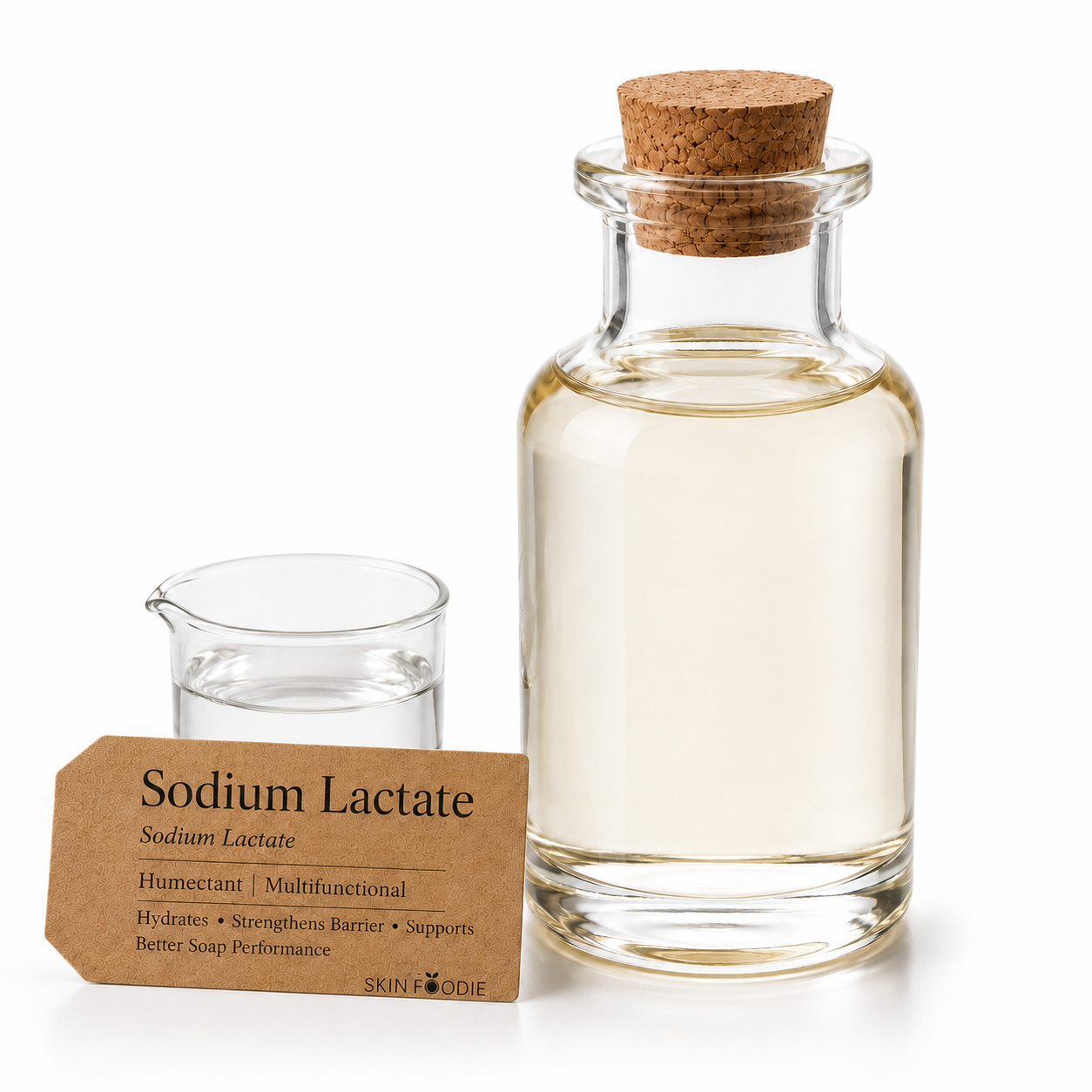
Appearance: Clear to light amber liquid
Solubility: Water-soluble
Phase: Water phase / cool down phase
Recommended Usage: 1–10%
Formulation Temperature: Can be added to the water phase, hot or cold, or during cool down depending on formula design
pH Function: Can help buffer acidic systems and may be used in some formulations to adjust pH upward
Why Formulators Love Sodium Lactate
Powerful Humectant Performance
Sodium Lactate helps bind water to the skin, supporting improved hydration, softness, and comfort.
Part of the Skin’s Natural Moisturising Factor
Because Sodium Lactate naturally occurs in the skin’s NMF system, it fits beautifully into moisturising and barrier-support formulations.
Excellent for Cold Process Soap
Helps produce harder, smoother bars with faster unmoulding and improved bar aesthetics.
Improves Skin Feel in Water-Based Systems
Adds a slick, almost emollient feel to aqueous formulations without requiring oils or esters.
Useful in Haircare & Detangling Systems
Its water-binding and slip-enhancing properties make it helpful in hydrating leave-ins, detanglers, and conditioning sprays.
Common Uses in Cosmetic Formulation
Sodium Lactate is widely used in:
• Moisturising serums
• Hydrating toners
• Barrier-support creams and lotions
• Facial mists
• Cleansers
• Body washes
• Hair detanglers
• Leave-in conditioners
• Cold process soap
• Shampoo bars and syndet bars
• Foot care and hand care formulations
• AHA/BHA support systems
Benefits
Skin Benefits
• Helps improve skin hydration
• Supports smoother, softer skin feel
• Helps reduce dryness and tightness
• Supports barrier-focused moisturising systems
• Adds elegant slip to water-based formulas
Hair Benefits
• Helps improve moisture retention in haircare systems
• Adds slip to detangling products
• Supports softer-feeling hair
• Useful in leave-in sprays and conditioning systems
Soap-Making Benefits
• Helps harden cold process soap bars
• Supports faster unmoulding
• Helps reduce cracking
• Improves finished bar aesthetics
• Can contribute to longer-lasting bars
Pro Tips
Sodium Lactate is one of those quiet ingredients that does serious backstage work.
• Use at 1–5% in leave-on skincare for hydration and improved skin feel
• Use up to 10% where higher humectancy is desired, depending on formula tolerance and product type
• In cold process soap, it is commonly added to cooled lye water to help harden bars
• Avoid overuse in leave-on products, as high levels of humectants can feel tacky depending on the overall formula
• Best paired with other hydration-support ingredients for a more complete NMF-inspired moisturising system
• Always check final product pH, especially when formulating with acids
Important correction: Sodium Lactate may support preservation strategy by lowering water stress in some systems, but it is not a complete broad-spectrum preservative. Always use an appropriate preservative system for water-containing formulations.
For enhanced performance, combine with:
• Hydroxyethyl Urea — deeper hydration and improved water-binding performance
• Glycerin — classic humectant support and improved moisture retention
• Propanediol — hydration boost and improved sensory elegance
Formulation Pairing — Multiple Intelligent Pathways
NMF-Style Hydrating Serum
Sodium Lactate + Hydroxyethyl Urea + Low Molecular Weight Hyaluronic Acid
→ Multi-level hydration + smoother skin feel + barrier-support positioning
Soap Hardening System
Sodium Lactate + Shea Butter + Castor Oil
→ Harder bars + improved lather + better unmoulding
Clarifying Acid Toner Support
Sodium Lactate + Lactic Acid + Allantoin
→ Hydration support + buffered acid system + improved comfort
Hydrating Hair Detangler
Sodium Lactate + BTMS + Polyquaternium
→ Moisture retention + slip + easier comb-through
Lightweight Gel-Cream System
Sodium Lactate + Propanediol + Olivem 1000
→ Hydration + elegant skin feel + light moisturising texture
Ingredient Comparisons & Alternatives
Sodium Lactate vs Glycerin
Both are humectants, but Sodium Lactate can deliver a slicker, less syrupy skin feel than glycerin. Glycerin is more universally used, while Sodium Lactate is especially valuable in NMF-style hydration systems and soap making.
Sodium Lactate vs Lactic Acid
Lactic Acid is an alpha hydroxy acid used mainly for exfoliation and pH adjustment, while Sodium Lactate is the sodium salt of lactic acid and functions mainly as a humectant, buffer, and soap-making additive.
Sodium Lactate vs Hyaluronic Acid
Hyaluronic Acid is famous for high water-binding performance and film-forming hydration, while Sodium Lactate works more like an NMF-support humectant that improves moisture retention and skin feel. They pair beautifully in advanced hydration formulas.
Sodium Lactate Pairs Well With
Sodium Lactate works beautifully with:
• Hydroxyethyl Urea
• Glycerin
• Propanediol
• Low Molecular Weight Hyaluronic Acid
• Allantoin
• Lactic Acid
• BTMS
• Castor Oil
• Shea Butter
• Olivem 1000
Formulation Inspiration
NMF Barrier Hydration Serum
Distilled Water — 83.2%
Propanediol — 5%
Sodium Lactate — 4%
Hydroxyethyl Urea — 3%
Glycerin — 3%
Allantoin — 0.3%
Low Molecular Weight Hyaluronic Acid — 0.2%
Hydroxyethyl Cellulose — 0.5%
Preservative — 0.8%
FAQs
1. Is Sodium Lactate the same as Lactic Acid?
No. Sodium Lactate is the sodium salt of lactic acid. Lactic Acid is mainly used as an exfoliating acid and pH adjuster, while Sodium Lactate is mainly used as a humectant, buffer, and soap-making additive.
2. Can Sodium Lactate be used in cold process soap?
Yes. Sodium Lactate is commonly added to cooled lye water in cold process soap to help harden bars, speed up unmoulding, reduce cracking, and improve bar aesthetics.
3. Is Sodium Lactate good for dry skin formulations?
Yes. It is an excellent humectant and part of the skin’s Natural Moisturising Factor, making it useful in formulas targeting dryness, dehydration, and rough skin feel.
4. Can Sodium Lactate replace a preservative?
No. Sodium Lactate may provide some supportive antimicrobial or water-activity benefits in certain systems, but it is not a complete broad-spectrum preservative. Water-containing formulas still require a proper preservative system.
5. Can Sodium Lactate be used directly on the skin?
It should be used as part of a properly formulated cosmetic product, not applied directly in concentrated form. Use appropriate dilution levels and always check final product pH.
6. Does Sodium Lactate make formulas sticky?
At moderate levels, it can improve slip and hydration. At higher levels, especially when combined with several other humectants, it may increase tackiness. Balance it with good sensory ingredients.
Shelf Life & Storage
Store in a cool, dry place away from direct sunlight and heat.
Keep tightly sealed when not in use.
Avoid introducing water or contaminants into the container.
The Skin Foodie Formulation Standard
At Skin Foodie, we believe exceptional skincare begins with exceptional ingredients and thoughtful formulation design. Our ingredients are carefully sourced to help formulators create products that are effective, stable, and beautifully balanced.
Because in cosmetic science, selecting the right ingredient is only the beginning, how ingredients are combined is what transforms a formula into a high-performance product.
Disclaimer
For cosmetic formulation use only. Not intended for ingestion or internal use.
All formulators are responsible for conducting proper research, compatibility testing, pH testing, preservative efficacy testing, and stability testing when developing cosmetic products.
The information provided on this page is for educational purposes only and should not be interpreted as medical advice.

Ijeoma E. (verified owner) –
Endurance Pollyn (verified owner) –
Rose A. (verified owner) –
Ngozi Caroline (verified owner) –
Des (verified owner) –
Hikmat (verified owner) –
This very good and work exactly as described.
Felicia (verified owner) –
I love it.
Anonymous (verified owner) –
Good
Adetayo (verified owner) –
Good
laure Aboubaraka (verified owner) –