

Description
Matcha – Green Tea Powder — Antioxidant Botanical Powder for Clarifying, Soothing & Radiance Skincare
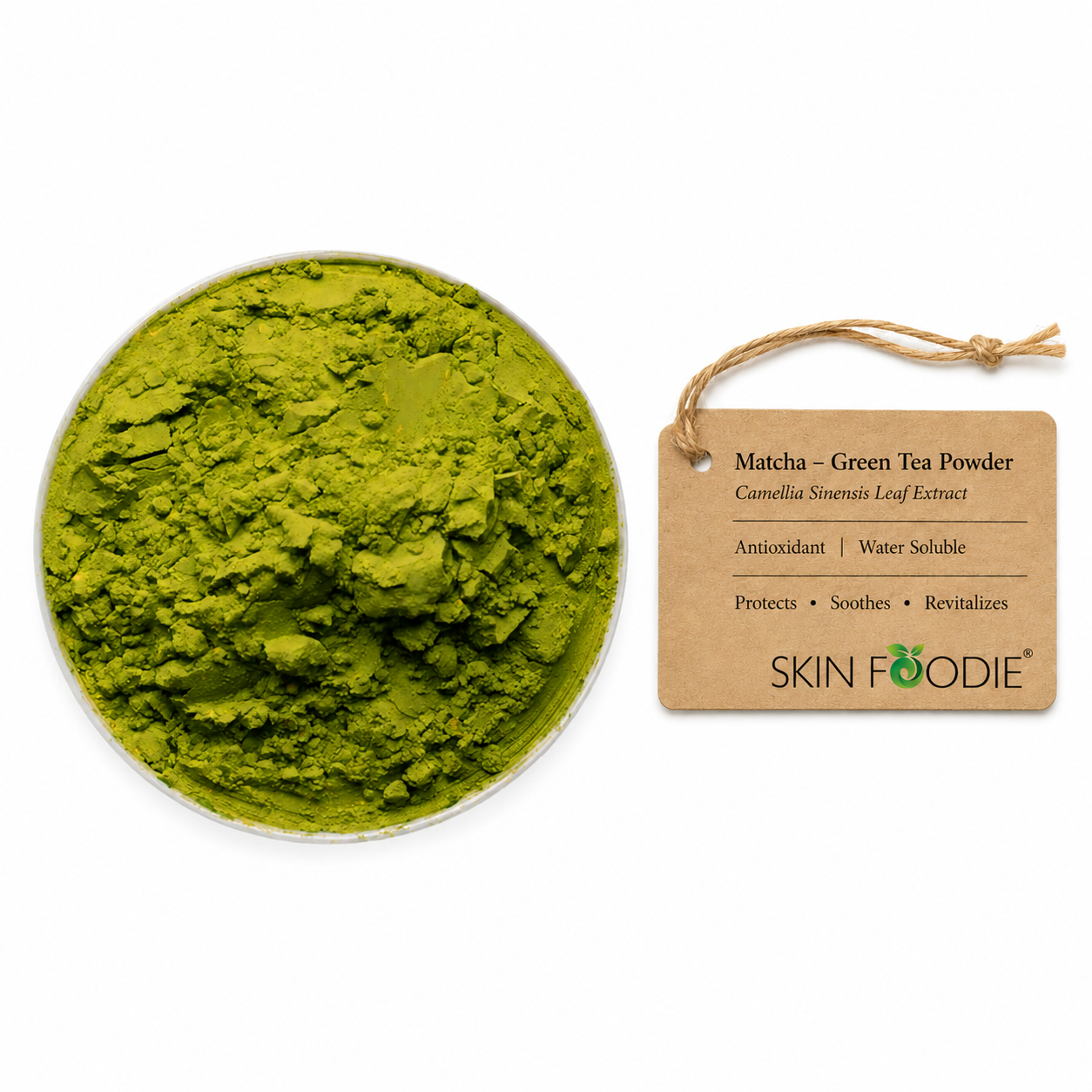
Matcha – Green Tea Powder is a premium botanical powder obtained from carefully processed green tea leaves and valued for its naturally occurring catechins, polyphenols, chlorophyll, and antioxidant compounds.
Unlike conventional green tea, matcha is produced from shade-grown leaves that are harvested, processed, and finely milled into a concentrated green powder. Because the entire leaf is used, Matcha Powder offers formulators a strong botanical ingredient story for antioxidant, clarifying, soothing, and radiance-focused products.
Its vibrant green colour and fine powdered texture make it especially suitable for facial masks, powdered cleansers, scrubs, soaps, scalp treatments, body products, and botanical skincare formulations where both performance and visual appeal matter.
At Skin Foodie, Matcha – Green Tea Powder is positioned as a versatile antioxidant botanical for formulators creating fresh, natural-looking products for dull, oily, combination, environmentally stressed, and blemish-prone skin.
Technical Specifications
INCI: Camellia Sinensis Leaf Extract
Common Names: Matcha Powder, Matcha Green Tea Powder, Green Tea Powder
Obtained From: Green tea leaves
Appearance: Fine green powder
Solubility: Water-dispersible
Recommended Usage: 0.1–1%
Phase: Cool down phase where applicable
Processing: Disperse thoroughly before incorporation
Compatibility: Suitable for powdered products, masks, cleansers, soaps, emulsions, gels, scalp products, and rinse-off formulations
Colour Consideration: The natural green colour may affect the appearance of the finished formulation
Storage: Store tightly sealed in a cool, dry, dark place away from moisture, heat, and direct sunlight
Why Formulators Love Matcha – Green Tea Powder
Antioxidant Botanical Positioning
Matcha is naturally rich in catechins and polyphenols, making it an excellent ingredient for antioxidant and environmental-stress skincare concepts.
Ideal for Clarifying Formulations
It works beautifully in products designed for oily, combination, congested, or blemish-prone skin.
Naturally Soothing
Green tea is widely used in cosmetic formulations designed to support calm, comfortable, and healthier-looking skin.
Strong Visual Appeal
Its vibrant green colour gives masks, cleansers, soaps, and botanical treatments a recognisable natural appearance.
Perfect for Face Masks
Matcha Powder is especially well suited for clay masks, powdered masks, cleansing powders, and spa-style facial treatments.
Versatile for Skin & Haircare
It can be incorporated into facial products, body treatments, scalp masks, shampoos, soaps, and deep-conditioning formulations.
Common Uses in Cosmetic Formulation
Matcha – Green Tea Powder is widely used in:
• Clay face masks
• Powdered facial masks
• Clarifying facial cleansers
• Cleansing powders
• Exfoliating scrubs
• Facial soaps
• Melt-and-pour soaps
• Cold-process soaps
• Gel masks
• Cream masks
• Antioxidant serums
• Facial moisturisers
• Body masks
• Body scrubs
• Scalp masks
• Clarifying shampoos
• Hair-conditioning treatments
• Spa and detox-inspired products
Benefits
Skin Benefits
• Provides antioxidant support
• Helps support skin exposed to environmental stress
• Promotes a fresher, more radiant-looking complexion
• Helps soothe the appearance of redness and discomfort
• Supports clearer-looking skin
• Suitable for oily, combination, dull, and blemish-prone skin
• Helps improve the appearance of tired-looking skin
• Supports smoother and healthier-looking skin
• Useful in clarifying and purifying product concepts
Hair & Scalp Benefits
• Adds antioxidant botanical positioning to haircare
• Suitable for clarifying scalp products
• Helps support fresh, balanced-looking scalp formulations
• Works well in powdered scalp masks and cleansing treatments
• Adds a premium green botanical story to shampoos and conditioners
Formulation Benefits
• Fine powder suitable for masks, soaps, and cleansers
• Naturally vibrant green appearance
• Suitable for anhydrous and water-based formulations
• Easy to incorporate into powdered products
• Provides strong antioxidant and botanical marketing appeal
• Works across skincare, body care, soap, and haircare applications
Important Formulation Notes
Matcha Powder is a natural botanical material, so colour, dispersion, and preservation must be considered carefully.
• Disperse thoroughly before adding to water-based formulations
• Pre-mix with glycerin, propanediol, or a small amount of the water phase to reduce clumping
• Add during cool down where possible to preserve botanical quality
• Its natural green colour may darken or change during storage
• Colour may vary slightly between batches because this is a botanical material
• High usage levels may produce a grainy texture or strong green colour
• Matcha Powder is not a preservative and does not replace a complete preservation system
• Water-containing products must be properly preserved
• Avoid prolonged exposure to high heat
• Protect finished products from direct light where possible
• Always conduct compatibility, pH, colour, preservative efficacy, and stability testing before scaling
Pro Tips
• Use 0.1–0.3% in serums, gels, and emulsions where only light colour is desired
• Use 0.3–1% in masks, cleansers, soaps, and rinse-off treatments
• Pre-disperse in glycerin or propanediol before adding to liquid formulations
• Pair with clays for clarifying masks
• Pair with humectants to reduce the dry feel associated with powdered masks
• Use with soothing ingredients for blemish-prone or reactive-looking skin products
• Keep packaging tightly sealed to protect the powder from moisture
• Use opaque or UV-protective packaging to help preserve the finished product’s colour
• Test the powder in a small batch because its green colour may shift in different pH systems
• Avoid describing Matcha Powder as a sunscreen or substitute for approved UV filters
For enhanced performance, combine with:
• Kaolin Clay — gentle oil absorption and mask structure
• Rhassoul Clay — mineral-rich cleansing and clarifying support
• Aloe Vera Powder or Extract — soothing botanical hydration
• Panthenol — comfort and moisture support
• Allantoin — soothing care for stressed-looking skin
• Niacinamide — tone, barrier, and sebum-support positioning
• Beta Glucan — hydration and calming support
• Hydroxyethyl Urea — lightweight hydration
• Green Tea Extract — enhanced green tea antioxidant positioning
• Salicylic Acid — clarifying pathway for oily and blemish-prone skin formulations
• Cucumber Extract — refreshing and soothing support
• Propanediol — humectancy and easier powder dispersion
Formulation Pairing — Multiple Intelligent Pathways
Clarifying Face Mask System
Matcha Powder + Kaolin Clay + Rhassoul Clay
→ Oil absorption + botanical antioxidant support + deep-cleansing mask positioning
Soothing Blemish-Prone Skin Mask
Matcha Powder + Aloe Vera Extract + Allantoin
→ Clarifying care + soothing support + improved skin comfort
Antioxidant Gel Mask
Matcha Powder + Hydroxyethyl Urea + Beta Glucan
→ Botanical antioxidant support + hydration + refreshing gel texture
Brightening Cleansing Powder
Matcha Powder + Rice Powder + Licorice Root Powder
→ Gentle cleansing + botanical radiance + smoother-looking skin
Clarifying Scalp Mask
Matcha Powder + Rhassoul Clay + Panthenol
→ Scalp cleansing + antioxidant support + conditioning care
Botanical Facial Soap
Matcha Powder + Kaolin Clay + Green Tea Extract
→ Natural green appearance + cleansing support + antioxidant product story
Ingredient Comparisons & Alternatives
Matcha Powder vs Green Tea Extract
Matcha Powder contains finely milled green tea leaf material and provides natural colour, texture, and botanical appeal. Green Tea Extract is usually more concentrated and may contain other plant parts, the liquid extract and may be easier to incorporate into serums, toners, and emulsions where a smoother finish is required.
Matcha Powder vs Spirulina Powder
Both powders provide strong natural colour and antioxidant positioning. Matcha produces a yellow-green to vibrant green appearance, while Spirulina usually creates a deeper blue-green colour and offers a marine botanical story.
Matcha Powder vs Moringa Powder
Matcha is especially recognised for catechin and green tea antioxidant positioning. Moringa Powder is often used for nutrient-rich, conditioning, and purifying botanical concepts.
Matcha Powder vs Green Clay
Green Clay primarily provides oil absorption and cleansing benefits. Matcha Powder adds antioxidant and botanical positioning but does not provide the same level of mineral-based oil absorption.
Matcha Powder vs Green Tea Hydrosol
Green Tea Hydrosol is a lightweight aqueous ingredient suitable for toners and mists. Matcha Powder is better suited for masks, powders, soaps, scrubs, and visibly botanical products.
Matcha – Green Tea Powder Pairs Well With
Matcha Powder works beautifully with:
• Kaolin Clay
• Rhassoul Clay
• Bentonite Clay
• Aloe Vera Extract
• Panthenol
• Allantoin
• Beta Glucan
• Hydroxyethyl Urea
• Niacinamide
• Green Tea Extract
• Cucumber Extract
• Licorice Root Extract
• Salicylic Acid
• Propanediol
• Spirulina Powder
• Cucumber extract
• Xanthan Gum Clear
Formulation Inspiration
Matcha Clarifying Face Mask
Formulation Inspiration
Part A — Dry Powder Mask
Kaolin Clay — 53%
Rhassoul Clay — 27%
Rice Powder — 16%
Colloidal Oatmeal — 3%
Matcha – Green Tea Powder — 1%
Part B — Hydrating Activator
Distilled Water — 71.2%
Rose Hydrosol — 15%
Propanediol — 5%
Glycerin — 3%
Licorice Root Powder — 1%
Aloe Vera Extract — 2%
Gel Panthenol — 1.5%
Allantoin — 0.3%
Preservative — 1%
Lactic Acid / Sodium Hydroxide — q.s. to pH 5–5.5
FAQs
- What is Matcha – Green Tea Powder used for?
Matcha Powder is used in antioxidant, clarifying, soothing, radiance, face mask, cleansing, soap, scalp, and botanical cosmetic formulations.
- Is Matcha Powder water-soluble?
It is water-dispersible rather than completely dissolving into a transparent solution. Some fine particles or sediment may remain.
- What is the recommended usage rate?
The manufacturer’s suggested usage rate is 0.1–1%.
- Can Matcha Powder be used in face masks?
Yes. It is especially suitable for clay masks, powdered masks, gel masks, and other clarifying facial treatments.
- Can Matcha Powder be used in soap?
Yes. It can be incorporated into melt-and-pour and cold-process soaps, although colour may change due to heat and alkaline pH.
- Can Matcha Powder be used in serums?
Yes, but use it at a low level and disperse it thoroughly. Liquid or filtered Green Tea Extract may be more suitable where a completely smooth or transparent serum is required.
- Will Matcha Powder make my formula green?
Yes. Matcha naturally adds a green colour, and the intensity depends on the usage level and the formulation base.
- Can Matcha Powder be used in haircare?
Yes. It can be used in scalp masks, shampoos, conditioners, and clarifying hair treatments.
- Is Matcha Powder a preservative?
No. Water-containing formulations still require a suitable broad-spectrum preservative.
- Can Matcha Powder be applied directly to the skin?
It should be incorporated into a properly designed cosmetic formulation. For dry masks, provide clear mixing and usage instructions to the finished-product customer.
Shelf Life & Storage
Store tightly sealed in a cool, dry, dark place away from moisture, heat, and direct sunlight.
Keep the container closed when not in use because exposure to moisture may cause clumping and deterioration.
The natural green colour may gradually change with exposure to air, heat, light, or unsuitable pH conditions.
Use clean, dry utensils when dispensing the powder to prevent contamination.
The Skin Foodie Formulation Standard
At Skin Foodie, we believe exceptional skincare begins with exceptional ingredients and thoughtful formulation design. Our ingredients are carefully sourced to help formulators create products that are effective, stable, and beautifully balanced.
Because in cosmetic science, selecting the right ingredient is only the beginning, how ingredients are combined is what transforms a formula into a high-performance product.
Disclaimer
For cosmetic formulation use only. Not intended for ingestion or internal use.
All formulators are responsible for conducting proper research, compatibility testing, pH testing, preservative efficacy testing, and stability testing when developing cosmetic products.
The information provided on this page is for educational purposes only and should not be interpreted as medical advice.

Good for face masks